 Swell
Swell connects ETH staking and restaking with liquid Ethereum tokens
Swell lets users stake ETH for swETH or restake ETH for rswETH, retaining a transferable token linked to their Ethereum position. The distinction is the underlying security arrangement: swETH represents liquid-staked ETH, while rswETH represents ETH natively restaked through EigenLayer. Both belong to the Ethereum product line, which the April 28, 2026 Swellchain sunset announcement explicitly left unaffected. The separate SWELL token and Fee Flow auctions connect protocol revenue with token utility.
Updated
What's inside
Keeping staking exposure in swETH or rswETH
Swell's published service terms require users to be at least 21 and complete know-your-customer (KYC) verification before staking. The terms exclude U.S. persons from liquid staking and restaking and bar users covered by their sanctions and territorial restrictions. An ETH deposit into the staking pool produces swETH, giving the holder a transferable representation of staked ETH. The restaking pool produces rswETH and connects its validators to EigenLayer. Choosing between these paths changes the underlying security commitment and the risks that accompany it.
Ethereum staking with swETH
swETH is a liquid staking token, or LST. Its underlying ETH supports Ethereum validators, and its reward accounting reflects the staking pool. The holder can keep the token in an Ethereum wallet or use it in a supported DeFi position. The pool handles validator operations, so the token holder does not need to operate a personal validator.
Native restaking with rswETH
rswETH is a liquid restaking token, or LRT. Its pool uses validators whose withdrawal credentials point to EigenLayer contracts. This arrangement enables their ETH to support additional actively validated services, or AVSs. These services use restaked security for distributed validation tasks. Their applicable slashing conditions add another layer of exposure to the Ethereum staking position.
Token balances and the ETH exchange rate
swETH accrues staking yield through its ETH exchange rate, without increasing the wallet's token count simply to pay rewards. rswETH also uses a repricing model. Token units and the ETH that they represent are therefore different quantities. A balance can stay unchanged while the underlying ETH value changes through reward accounting.
The protocol rate describes the underlying ETH value that the token represents. A market quote describes the ETH available from a particular trade. These rates can differ because market liquidity and trading demand affect a sale. Reading a token balance alone leaves out that distinction, especially when comparing the value of a position with the proceeds available from selling it.
A hypothetical choice between Ethereum staking and restaking
In this hypothetical case, a reader holds ETH on Ethereum mainnet and wants staking exposure through a liquid token. The question is whether choosing rswETH also requires moving the position onto Swellchain.
The staking path produces swETH; the native-restaking path produces rswETH. Both are Ethereum products. EigenLayer supplies the additional restaking arrangement, while Swellchain was a separate Layer 2 network with its own bridge balances.
Choosing rswETH does not itself require a Swellchain deposit.
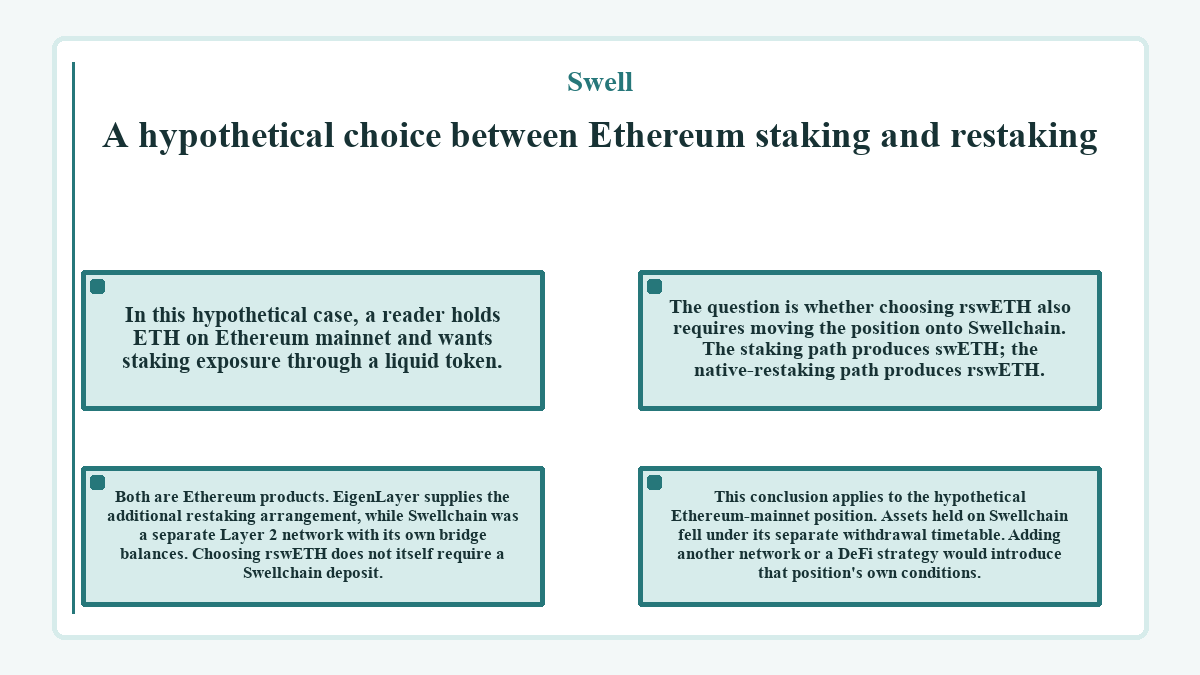
This conclusion applies to the hypothetical Ethereum-mainnet position. Assets held on Swellchain fell under its separate withdrawal timetable. Adding another network or a DeFi strategy would introduce that position's own conditions.
Protocol withdrawals and secondary-market sales
A protocol withdrawal redeems the token against underlying ETH, while a secondary-market sale exchanges it using market liquidity. Their waiting periods and prices can differ, even when both routes return ETH.
swETH redemption
The Barracuda release on March 7, 2024 enabled primary-market withdrawals for swETH. Its design represents each request with an unstake NFT, and the holder claims ETH when processing finishes. Ethereum validator exits, sweep timing, and withdrawal demand affect the wait.
rswETH redemption
rswETH gained primary-market withdrawals in the July 31, 2024 v2 rollout. Redemptions that require an EigenLayer withdrawal face its 14-day delay, introduced with slashing. Overall processing can extend to 28 days, with occasional delays beyond that. The withdrawal buffer can fund redemptions without validator exits. Requests that exceed it may face longer queues, including Ethereum exit and sweep delays.
Secondary-market sales
A market sale depends on the DEX's available liquidity and quoted price. It can avoid the protocol redemption queue, but the swap rate can differ from the primary-market rate. Slippage may reduce proceeds, particularly when the trade is large relative to available liquidity.
Reward fees, transaction costs, and changing returns
Staking commission and Ethereum gas apply to different bases. A staking fee charged on rewards reduces the yield from those rewards. Gas pays for blockchain transactions such as deposits, withdrawals, and swaps. Additional DeFi positions can introduce their own trading or strategy costs.
An annualized yield figure does not fix the return over a particular holding period. Validator performance, reward accrual, and applicable fees affect what the staking position earns. The token's ETH value also differs from its value in another currency. Positive staking rewards measured in ETH can coincide with a falling cash value when ETH's market price declines.
SWELL and Fee Flow auctions
SWELL is an ERC-20 governance token on Ethereum with a separate role from swETH and rswETH. Fee Flow uses it to purchase protocol revenue accumulated from the staking products. Its Dutch-auction price declines until a buyer settles, and the SWELL used in the purchase goes to a burn address. Burning reduces token supply; the purchase transfers the auctioned fee assets to the buyer. Holding SWELL alone is different from buying those assets in an auction.
Swellchain's announced withdrawal timetable
The April 28, 2026 announcement, Sunsetting Swellchain: From L2 to Faro, set out a wind-down for the Optimism Superchain L2. Its detailed timetable separated the withdrawal frontend cutoff from a later end of chain operation.
Closure of inbound deposits
The notice listed May 5, 2026 as the date for disabling deposits from Ethereum. The plan closed new inbound bridging before the withdrawal frontend cutoff, creating a period intended for moving existing assets out.
The withdrawal frontend cutoff
The April 28, 2026 sunset notice set June 15, 2026 as the cutoff for initiating withdrawals through the Swellchain frontend. Users with Swellchain DeFi positions needed to unwind those positions before bridging out. The announced route used Superbridge to return assets to Ethereum. Withdrawals initiated before June 15 could still be finalized on Ethereum, subject to the 7-day proof window.
The limited technical window
The plan allowed chain operation until June 30, 2026, with a technical window for direct contract withdrawals after frontend support ended. It described that path as requiring technical expertise. Those announced deadlines have passed, and the notice warned that funds left behind might be unrecoverable.
Faro and the change in product focus
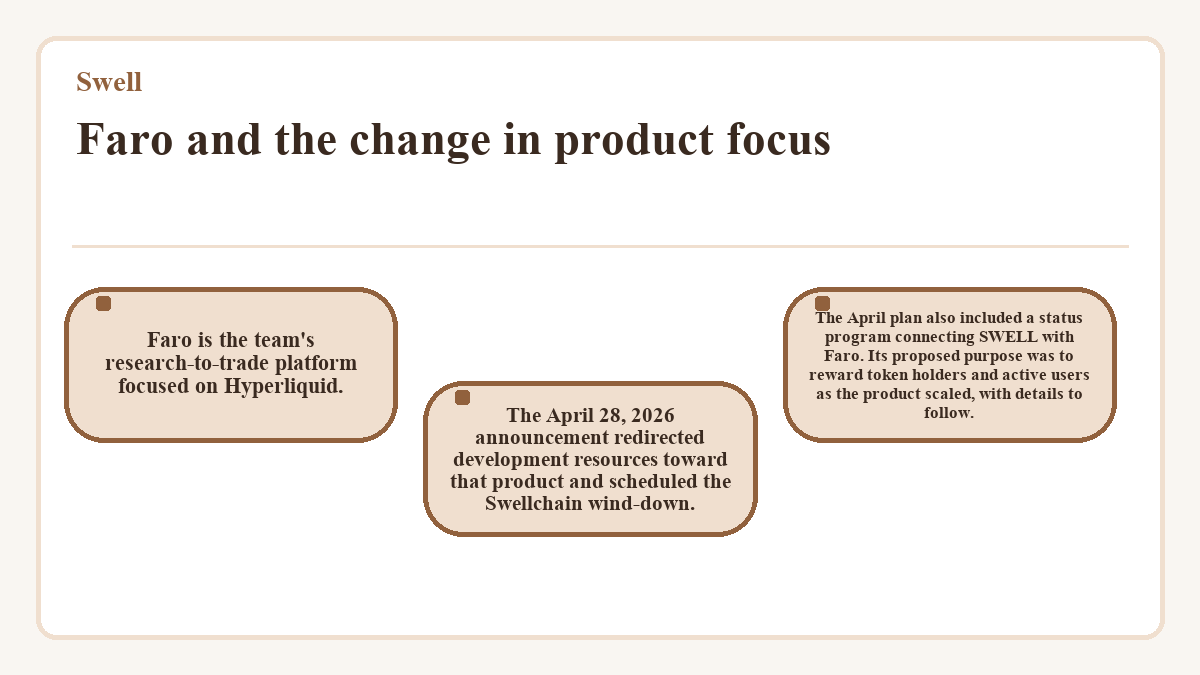
Faro is the team's research-to-trade platform focused on Hyperliquid. The April 28, 2026 announcement redirected development resources toward that product and scheduled the Swellchain wind-down.
The April plan also included a status program connecting SWELL with Faro. Its proposed purpose was to reward token holders and active users as the product scaled, with details to follow.
Restaking integrations and additional yield strategies
swETH can also enter a separate restaking position. The ecosystem includes integrations with EigenLayer and Symbiotic for that purpose. Their deposit availability and position rules govern the additional commitment. The ecosystem also lists King for claiming restaking rewards, a separate function from minting a liquid token.
Derive offers options vaults using rswETH, while Sommelier provides strategies using swETH. Equilibria connects swETH with Pendle-based yield opportunities. A strategy's accepted deposit asset can differ from the staking token that it uses. Their returns come from the external strategy as well as the underlying staking exposure, so the strategy's conditions affect the combined position.
Audits and reserve monitoring
Smart contract audits examine particular code and versions. Sigma Prime and Hexens appear in the protocol's security work, alongside an Immunefi bug bounty program. Their presence does not extend an audit automatically to every external vault or later contract change. A DeFi integration adds contracts beyond the underlying staking token.
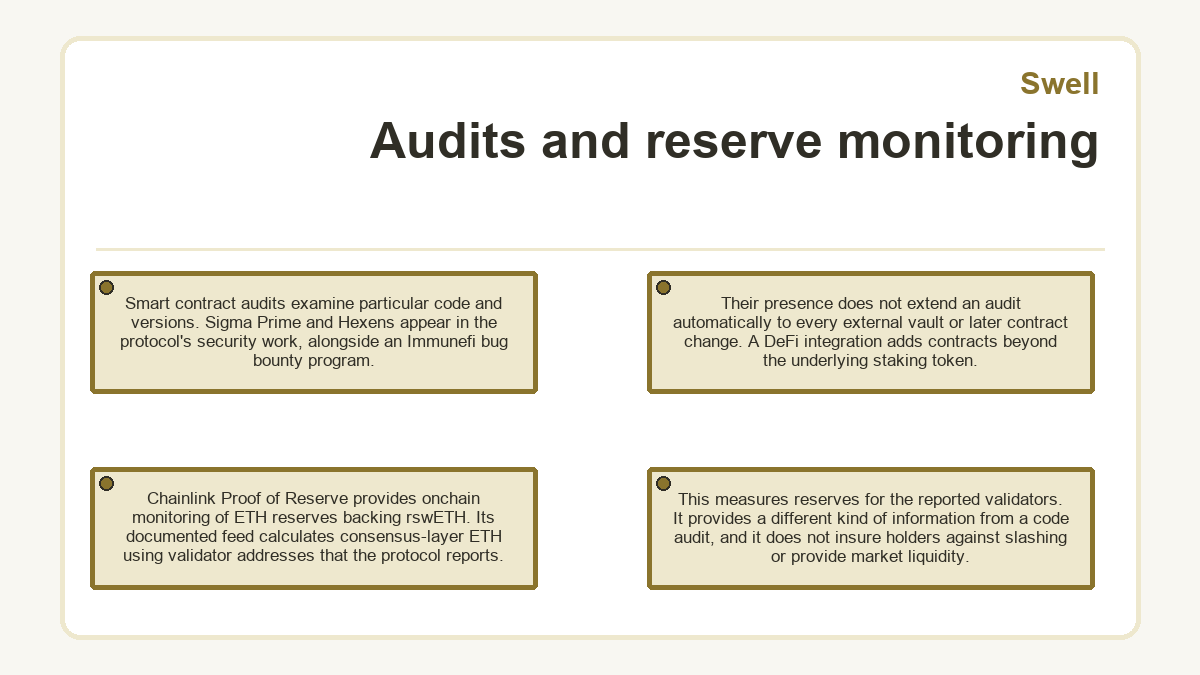
Chainlink Proof of Reserve provides onchain monitoring of ETH reserves backing rswETH. Its documented feed calculates consensus-layer ETH using validator addresses that the protocol reports. This measures reserves for the reported validators. It provides a different kind of information from a code audit, and it does not insure holders against slashing or provide market liquidity.
Risks that follow the token into DeFi
Validator penalties and slashing can reduce the ETH underlying a staking position. Native restaking adds exposure to the applicable conditions of additional services. Smart contract failures can also affect the staking pool or an external strategy.
Borrowing against a staking token introduces liquidation risk alongside staking exposure. The lending market applies its own collateral rules, and accumulated staking rewards do not remove those rules. A leveraged position can therefore lose its collateral through liquidation before its holder would otherwise choose to redeem the staking token.
Everyday questions about Swell
-
Can I get rswETH by restaking swETH directly on EigenLayer?
- Restaking swETH directly on EigenLayer does not itself issue rswETH. The rswETH product uses a separate native-restaking pool, with validators connected directly to EigenLayer. Depositing an LST into another protocol and receiving a liquid restaking token from its own pool are distinct arrangements, even when both involve restaking.
-
What does transferring a swEXIT NFT change?
- Transferring a swEXIT NFT transfers the right to claim the ETH associated with that swETH withdrawal request. The Barracuda withdrawal design allows the NFT to be transferred or sold. Its new owner can redeem the unstaked ETH, and the former owner loses that claim. The NFT represents a specific withdrawal, rather than an ordinary swETH balance.
-
Can a queued swETH withdrawal be cancelled?
- A swETH withdrawal cannot be cancelled once it enters the queue under the Barracuda withdrawal design. The request must finish processing before the ETH can be claimed. This restriction concerns queued protocol redemption; it is separate from deciding whether to sell swETH through a secondary market before requesting redemption.
-
What did rswETH's zero-fee launch offer cover?
- The January 29, 2024 rswETH release offered zero protocol fees for the first 30 days following launch. That was a shared launch period, rather than a new 30-day allowance for each depositor. The offer concerned protocol fees and did not eliminate Ethereum transaction costs.
-
Does moving swETH between Ethereum wallets create a withdrawal request?
- An ordinary swETH transfer moves the liquid token between Ethereum addresses without redeeming the underlying ETH. The recipient holds the transferred token position. Protocol redemption uses a separate withdrawal request, represented by an unstake NFT in the Barracuda design. Moving swETH and claiming unstaked ETH therefore change different assets.
-
Are staking transactions hidden from other Ethereum users?
- Ethereum staking transactions use public blockchain records. Address activity and token movements can be inspected onchain, so a wallet address is not a confidential account identifier. Holding the keys to a wallet controls authorization; it does not make the wallet's staking transactions or token transfers private.
-
How did launch-era Pearls differ from ETH staking rewards?
- Pearls tracked the Voyage airdrop allocation in the January 29, 2024 rswETH launch program, while staking rewards came from the underlying ETH position. The launch also listed EigenLayer Restaked Points as a measure of restaking participation. Those point balances were separate from the token's ETH exchange rate and staking yield.