 Swell
Swell rswETH can be redeemed through a queue or sold at a market price
Swell rswETH offers an ETH exit through queued redemption or a secondary-market swap. Redemption uses the protocol's primary exchange rate and can require a wait. A decentralized exchange (DEX) sale depends on available liquidity, its executable price, and slippage. A compatible route and the net ETH received determine whether a displayed swap quote meets the holder's exit needs.
Updated
rswETH represents ETH natively restaked through EigenLayer. Its token balance, underlying ETH value, and executable sale quote describe different quantities. Converting that position back to ETH requires distinguishing a withdrawal request from a completed claim or market sale.
Queued ETH redemption and secondary-market liquidity
Primary-market redemption draws ETH through the restaking pool's withdrawal process, while a DEX sale uses secondary-market liquidity.
Redemption from the restaking pool
The protocol uses its primary rate to value the rswETH submitted for redemption. Its timing reflects available ETH and any underlying exits that the pool needs. Swell's terms require users of its services to be at least 21 and comply with its territorial and sanctions restrictions. They also permit unstaking limits or pauses, so a compatible token alone does not guarantee acceptance of a new request. The primary rate provides a valuation basis, without making the corresponding ETH immediately spendable.
A sale against market liquidity
A DEX sale exchanges rswETH against available market liquidity. It can settle without starting a protocol redemption. The actual sale price, applicable trading charges, and gas determine its proceeds. An aggregator's route must support the correct rswETH token on Ethereum and the intended output asset.
Restaking delays and the available ETH buffer
The rswETH withdrawal queue combines EigenLayer constraints with Ethereum validator operations, while available ETH can avoid some underlying exits.
EigenLayer and validator exits
rswETH redemptions may take up to 28 days, with occasional delays beyond that estimate. An EigenLayer native restaking withdrawal carries a 14-day delay when that exit is required. Ethereum's validator exit queue and sweep state also affect when underlying ETH becomes available. These components describe different processing constraints, so a single countdown cannot represent every request. Swell's July 31, 2024 rswETH v2 rollout described a seven-day EigenLayer delay within its earlier estimate. The later withdrawal design incorporates the increase to 14 days following EigenLayer's slashing upgrade.
Available ETH and request size
Swell maintains a buffer of staking rewards and daily deposits that can fund withdrawals without exiting validators. Requests that exceed available liquidity can require underlying exits and take longer. The EigenLayer delay therefore applies to that underlying exit, rather than imposing a mandatory 14-day wait on every buffered redemption.
When does a withdrawal become spendable ETH?
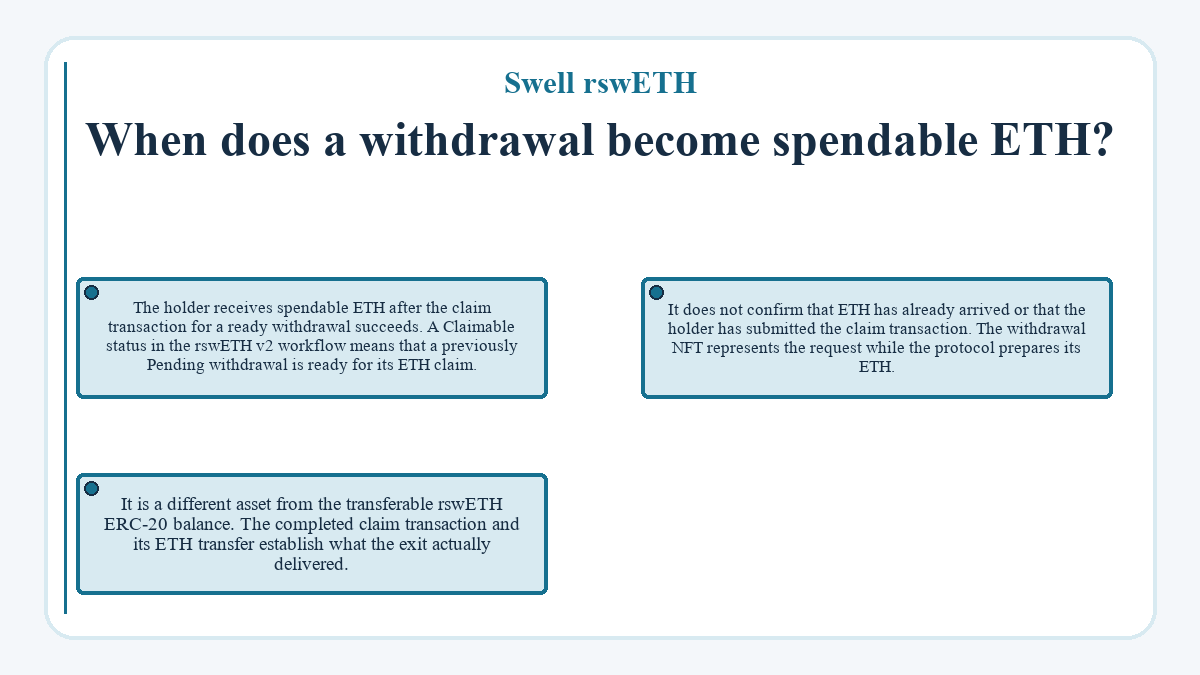
The holder receives spendable ETH after the claim transaction for a ready withdrawal succeeds. A Claimable status in the rswETH v2 workflow means that a previously Pending withdrawal is ready for its ETH claim. It does not confirm that ETH has already arrived or that the holder has submitted the claim transaction. The withdrawal NFT represents the request while the protocol prepares its ETH. It is a different asset from the transferable rswETH ERC-20 balance. The completed claim transaction and its ETH transfer establish what the exit actually delivered.
Ethereum exits and the Swellchain bridge cutoff
Swell's April 28, 2026 announcement, Sunsetting Swellchain: From L2 to Faro, set a June 15, 2026 cutoff for initiating withdrawals through Swellchain's bridge frontend. It explicitly left rswETH operations on Ethereum unaffected. That announced bridge cutoff concerned funds on Swellchain; it did not impose the same deadline on Ethereum rswETH redemptions.
Spendable tokens and a compatible swap quote
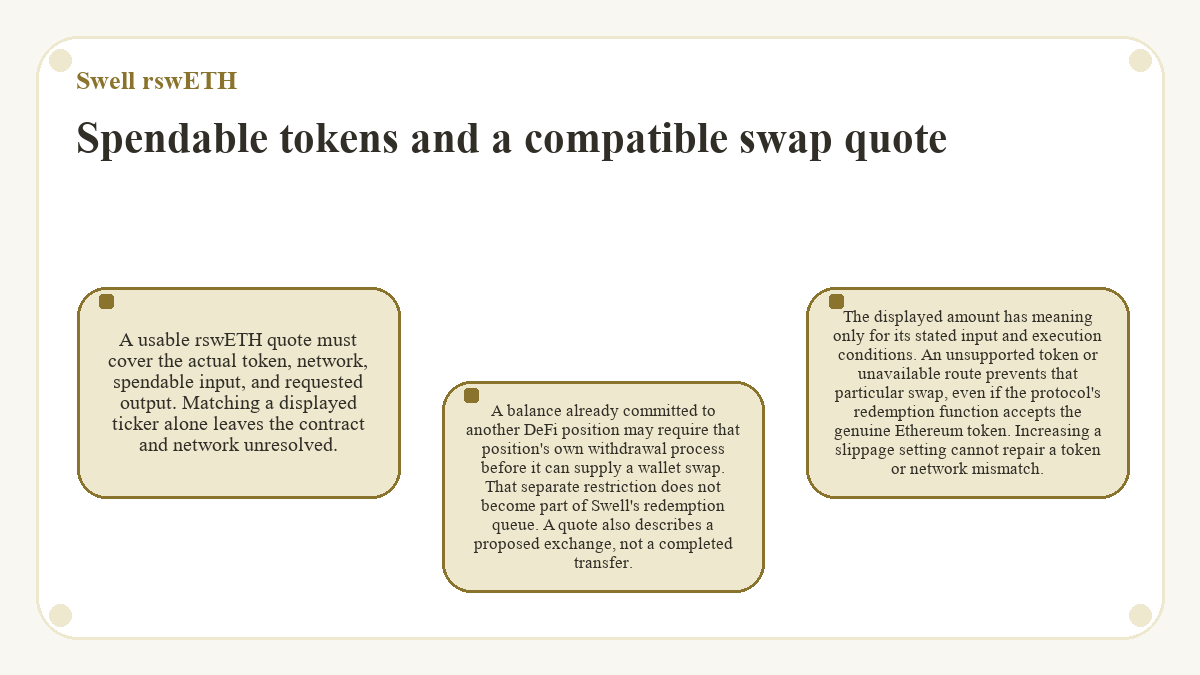
A usable rswETH quote must cover the actual token, network, spendable input, and requested output. Matching a displayed ticker alone leaves the contract and network unresolved. A balance already committed to another DeFi position may require that position's own withdrawal process before it can supply a wallet swap. That separate restriction does not become part of Swell's redemption queue.
A quote also describes a proposed exchange, not a completed transfer. The displayed amount has meaning only for its stated input and execution conditions. An unsupported token or unavailable route prevents that particular swap, even if the protocol's redemption function accepts the genuine Ethereum token. Increasing a slippage setting cannot repair a token or network mismatch.
The primary rate and an executable ETH price
The primary exchange rate expresses the ETH value represented by each rswETH token through pool accounting. Its repricing design reflects accrued rewards through that rate, without requiring the wallet's token count to rise. A secondary-market price can differ even when a sale executes exactly at its quote. Chainlink Proof of Reserve concerns reported backing; it does not set the price that market liquidity will pay for an rswETH sale.
A hypothetical comparison with a compatible ETH route
All balances, rates, quotes, costs, and execution outcomes in this example are hypothetical. The starting balance is 1.238 rswETH on Ethereum, available in the wallet, with ETH as the desired output. Both the redemption function and the proposed swap must accept that genuine token before their amounts can be compared.
At a primary rate of 1.08 ETH per rswETH, the balance represents 1.33704 ETH before exit costs. Holding that rate constant for this comparison, combined redemption costs of 0.0038 ETH leave 1.33324 ETH after the claim settles. The waiting period remains separate from this arithmetic.
The compatible DEX route quotes 1.3098 ETH for the same token balance. Execution at that quoted output, with 0.0028 ETH of costs not already reflected in the quote, leaves 1.307 ETH net. The modeled market exit therefore delivers 0.02624 ETH less than redemption, in exchange for avoiding the protocol's withdrawal wait.
On the working route, the completed swap exchanges the spendable rswETH balance for ETH. Confirmed transfers of rswETH and ETH, together with actual transaction charges, provide a separate check on the modeled proceeds. A quote screen alone cannot establish that the swap delivered its displayed amount.
If the interface cannot quote the actual Ethereum token, that interface provides no usable sale route. Raising slippage does not fix that incompatibility. A supported redemption remains an alternative, but an NFT recording a pending request cannot substitute for spendable rswETH in the rejected swap.
Slippage limits, gas, and market execution
A slippage limit bounds adverse execution when the chosen swap enforces that limit. Price impact describes the effect that trade size has on available market prices. Slippage describes movement between the quote and execution. A discount to the primary rate can already exist in the quote, before any additional slippage occurs. Wider tolerance permits a worse fill; it does not create liquidity.
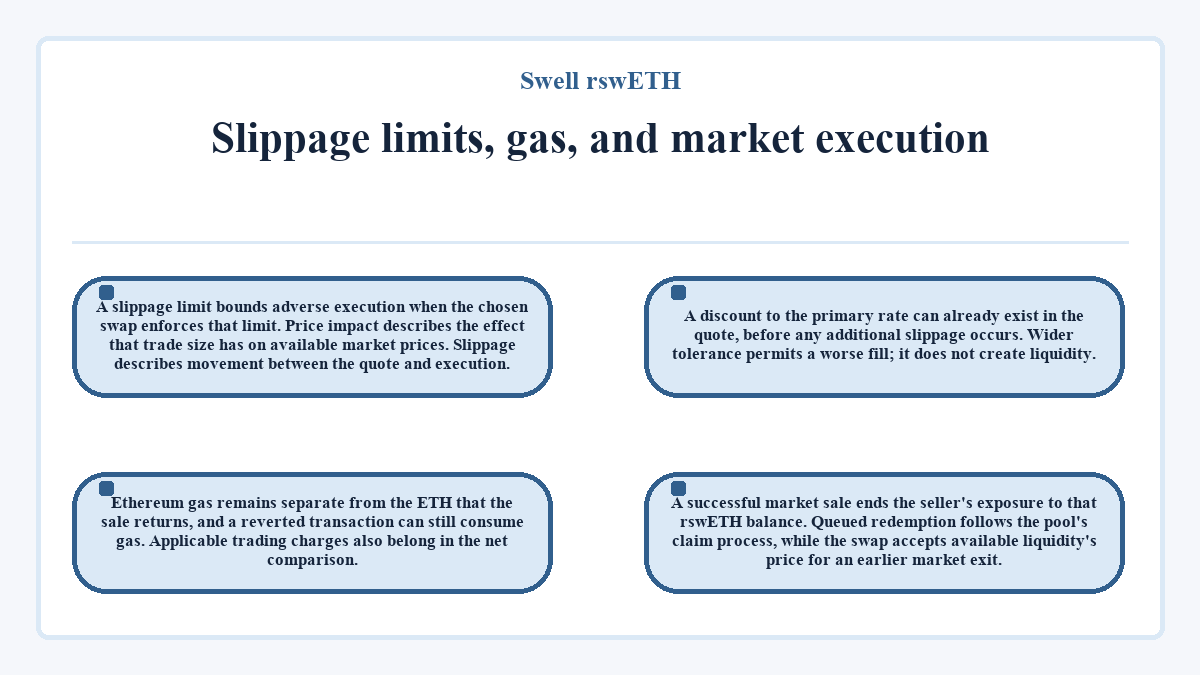
Ethereum gas remains separate from the ETH that the sale returns, and a reverted transaction can still consume gas. Applicable trading charges also belong in the net comparison. A successful market sale ends the seller's exposure to that rswETH balance. Queued redemption follows the pool's claim process, while the swap accepts available liquidity's price for an earlier market exit.
Things people ask about Swell rswETH
Will an rswETH token approval let a DEX sell my withdrawal NFT?
An rswETH ERC-20 approval does not authorize selling the separate withdrawal NFT. The approval concerns the specified fungible token balance, while the NFT represents a redemption request. A swap quote for rswETH therefore does not establish support for trading that request. The NFT should not be counted as additional spendable rswETH.
Why can underlying ETH remain slashable during an rswETH withdrawal?
EigenLayer's withdrawal delay allows applicable slashing conditions to cover stake pending withdrawal. Its slashing design gives services time to account for that stake before release. Exposure depends on the relevant service conditions and operator participation; the upgrade did not automatically enroll every operator or staker into every service's slashing conditions.
Does selling rswETH automatically convert EigenLayer points into ETH?
Selling rswETH exchanges the token balance for the route's output asset and does not itself redeem a separate points balance. A DEX quote prices the token sale; it should not be read as a separate ETH payout for points associated with earlier restaking activity.
Can SWELL replace ETH for the gas on an rswETH exit?
Ethereum gas for an rswETH transaction is paid in ETH, so SWELL does not replace it. Fee Flow uses SWELL to purchase protocol revenue held in swETH and rswETH, then burns the SWELL received. That auction mechanism serves a different purpose from paying network gas or claiming an individual ETH withdrawal.
Was primary-market redemption available when rswETH first launched?
Primary-market rswETH withdrawals were not live at the January 29, 2024 launch. Swell enabled the app's ETH withdrawal function in the July 31, 2024 rswETH v2 rollout. The original v1 restriction describes that launch stage; the later rollout introduced a redemption request, an unstake NFT, and an ETH claim.
Does an rswETH-to-ETH swap fix the dollar value of my exit?
An rswETH-to-ETH swap establishes its ETH output when execution completes, while the dollar value of that ETH can continue changing. Faster conversion out of rswETH therefore does not turn an ETH-denominated exit into a fixed dollar payment.