 Swell
Swell Fee Flow auctions protocol revenue for SWELL and burns the payment
Swell Fee Flow sells accumulated swETH and rswETH protocol fees through Dutch auctions and burns the SWELL payment. Buyers compare that payment with the offered assets' value and include Ethereum gas in the acquisition cost. The price falls until buyers clear the available supply. A lower quote can improve the exchange, although changing token values and transaction costs can remove an apparent saving. Swell announced the mechanism on March 6, 2026.
Updated
The SWELL payment and the assets it buys
The acquisition cost starts with the quoted SWELL payment, the quantities of swETH and rswETH offered, and the Ethereum gas needed to transact. These amounts use different units. Adding a SWELL balance to an ETH gas estimate produces no meaningful total until both amounts share a valuation unit.
A common unit for the comparison
An ETH-denominated comparison values each offered token quantity in ETH, then adds those values. The estimated margin equals that combined value minus the SWELL payment's ETH value and transaction costs not already reflected in those values. Prices need the same valuation time and a consistent basis. Underlying exposure and executable sale proceeds answer different questions.
Underlying ETH value
The protocol exchange rate expresses the underlying ETH represented by swETH or rswETH. Each token refers to its own pool. Multiplying an auction's token quantity by that token's ETH exchange rate estimates its underlying exposure. Reserve monitoring concerns the ETH backing those tokens; it does not turn that backing into immediately available sale proceeds.
Market sale value
An executable market quote answers how much ETH a sale could return for the offered quantity. Liquidity, slippage, and trading charges can make that amount differ from the underlying valuation. Using a quoted sale value avoids treating the staking exchange rate as a market bid. Any later redemption follows the relevant token's withdrawal conditions.
Retaining the fee tokens makes their underlying exposure relevant. A planned resale instead calls for executable proceeds, with costs counted on the same basis.
Collection, auction, and burn timing
Fee Flow moves staking-product revenue through collection, auction, and burning. Swell's March 6, 2026 launch described recurring auctions every 14 days. That interval belongs to the announced design; it is not a guaranteed time to obtain a particular quote or complete a purchase.
| Fee Flow stage | Timing and completion condition |
|---|---|
| Collection of swETH and rswETH fees | Revenue accrues as Swell's staking products generate protocol fees. |
| Dutch auction | The launch design specifies a 14-day cadence; the sale closes when buyers clear supply. |
| SWELL burn | After the sale, the SWELL received goes to a burn address. |
| Economic outcome | Buyers acquire protocol fee assets, and the SWELL payment enters the burn process. |
The burn quantity follows the SWELL payment that the protocol receives. Counting the swETH and rswETH tokens sold cannot establish that payment without the auction price. A sale can therefore move very different token counts on its two sides.
When does a falling auction quote improve the purchase?
A lower SWELL quote reduces the purchase cost in SWELL when the offered inventory stays unchanged. Its cost in ETH can move differently if SWELL's market value changes. The fee assets can also move in value while the auction runs, so the descending quote alone cannot establish a fixed discount. The Dutch auction ends when buyers clear the offered supply. Waiting introduces competition for that inventory. A target quote may never remain available long enough for another buyer to act. The high starting price and decline toward zero describe price discovery without promising a profitable purchase.
Network costs outside the auction quote
Ethereum gas adds a separate network expense to the SWELL payment. Ethereum burns the base fee and pays the priority fee to the block's validator. The budget therefore needs ETH for gas alongside the auction currency. Acquiring SWELL through a separate conversion may add trading costs, and selling acquired fee tokens can add further gas and slippage. Those costs belong in the comparison when the intended purchase requires those transactions.
Reward fees and the auction's token burn
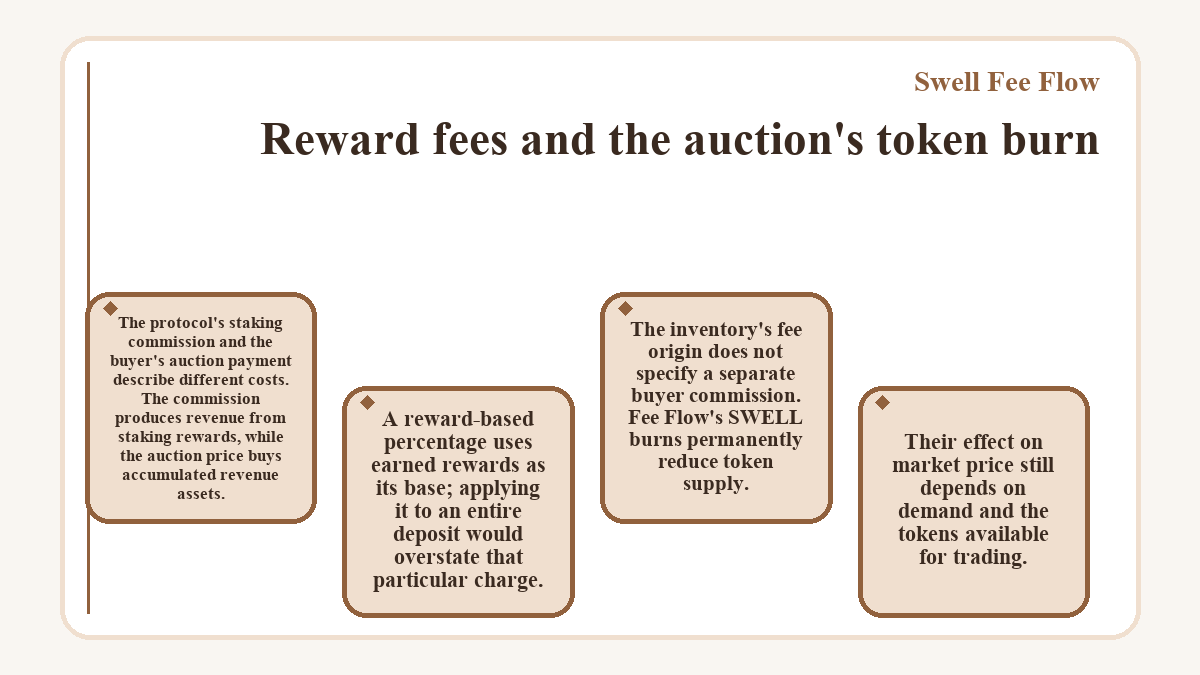
The protocol's staking commission and the buyer's auction payment describe different costs. The commission produces revenue from staking rewards, while the auction price buys accumulated revenue assets. A reward-based percentage uses earned rewards as its base; applying it to an entire deposit would overstate that particular charge. The inventory's fee origin does not specify a separate buyer commission.
Fee Flow's SWELL burns permanently reduce token supply. Their effect on market price still depends on demand and the tokens available for trading.
Ethereum scope and later revenue plans
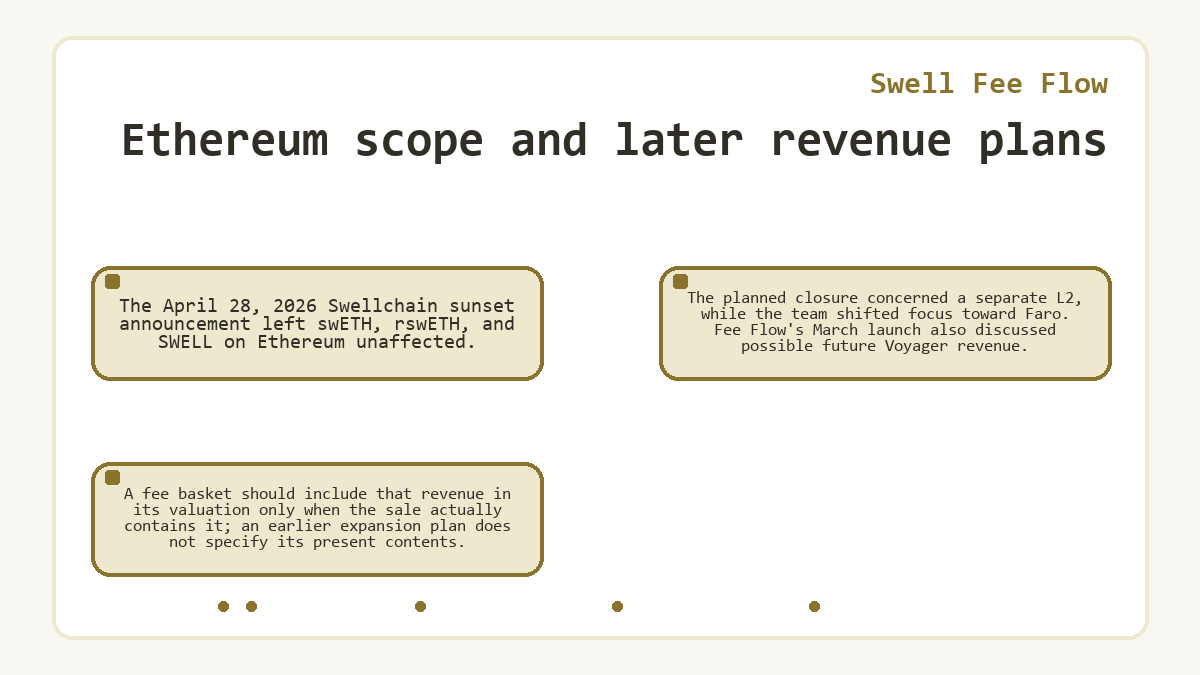
The April 28, 2026 Swellchain sunset announcement left swETH, rswETH, and SWELL on Ethereum unaffected. The planned closure concerned a separate L2, while the team shifted focus toward Faro. Fee Flow's March launch also discussed possible future Voyager revenue. A fee basket should include that revenue in its valuation only when the sale actually contains it; an earlier expansion plan does not specify its present contents.
Auction inventory versus a direct token purchase
A secondary-market purchase offers another way to acquire swETH or rswETH, using the market's quoted output and applicable trading costs. An auction offers the fee inventory available for SWELL. A fair cost comparison holds the desired asset exposure and valuation time consistent, then includes the charges needed for each method.
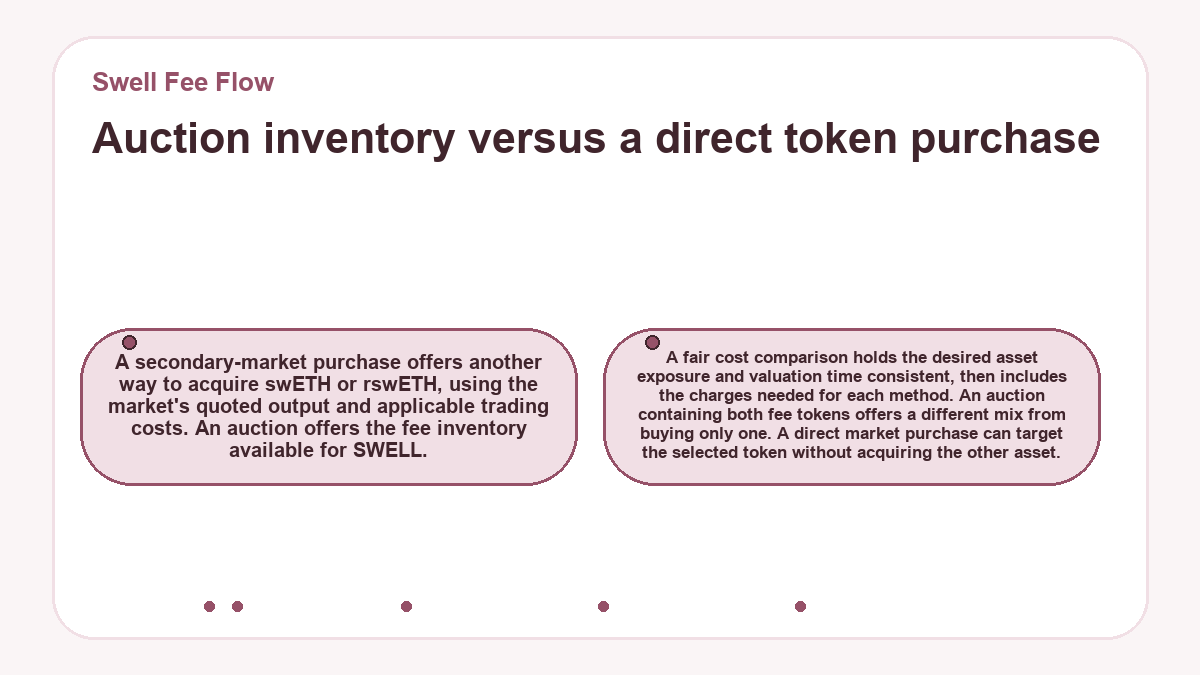
An auction containing both fee tokens offers a different mix from buying only one. A direct market purchase can target the selected token without acquiring the other asset.
Questions worth asking
-
Can arbitrageurs buy revenue through Swell Fee Flow?
- The launch design explicitly includes arbitrageurs among potential auction participants. Swell's service eligibility rules still apply: users must meet the minimum age of 21 and comply with applicable sanctions and territorial restrictions. Open participation in an auction does not make every person eligible for every Swell service or remove restrictions on particular activities.
-
Why can total SWELL burns exceed Fee Flow burns?
- Overall SWELL burn figures can include supply reductions outside revenue auctions. Fee Flow's contribution consists of SWELL paid to purchase protocol fees. The March 6, 2026 launch announcement also referred to separate regular burns.
-
Does purchasing fee inventory create a right to future Swell revenue?
- Purchasing auction inventory buys the fee assets offered in that sale. Future collections produce separate inventory under the auction mechanism. A payment for one basket does not represent a percentage ownership interest in all later fees. SWELL's governance role also does not confer equity, dividends, or profit rights in the protocol operator.
-
Are completed Fee Flow purchases refundable?
- Swell's payment terms exclude transaction refunds and state that it cannot reverse blockchain payments. A completed auction purchase therefore does not carry a refund simply because token values later change.
-
How should Euler's fee flow design inform a Swell cost comparison?
- Euler's fee flow design explains the auction concept, while the applicable Swell auction determines the payable amount. Swell adapted the mechanism for its own revenue assets and token structure. A shared model does not establish matching starting prices or price paths, so importing another protocol's settings can misstate the cost.
-
Is a Fee Flow auction discount an annual percentage yield?
- An auction discount compares a fee basket's value with its purchase price at a particular time. Annual percentage yield concerns returns over a year with compounding. A single favorable purchase does not establish repeated access or reinvestment at the same terms. The launch's 14-day cadence therefore does not create a dependable annual return.